Research
Sub-GeV Dark Matter in the Sun
My current research focuses on sub-GeV dark matter (DM) captured and accumulated in the Sun. When galactic dark matter particles enter the Sun, they undergo elastic scattering with solar nuclei (primarily hydrogen), lose kinetic energy, and become gravitationally bound. Over time, processes of capture, evaporation, and annihilation reach equilibrium, and the resulting annihilation products — such as neutrinos and gamma rays — may be detected by experiments like Super-Kamiokande and Fermi-LAT.
Based on the theoretical framework of Garani & Palomares-Ruiz (2017) and the AGSS09 standard solar model, I developed a complete numerical computation pipeline (DaMaSCUS-SUN) covering:
- DM spatial distribution in both the Knudsen limit (isothermal) and LTE limit (local thermal equilibrium with thermal diffusion), with a Knudsen-number-based interpolation for intermediate regimes
- Evaporation rate calculation including optical depth suppression and angular/multiple-scattering corrections
- Annihilation signal flux at Earth, compared against current experimental constraints
Accelerating DM Simulation with Diffusion Models
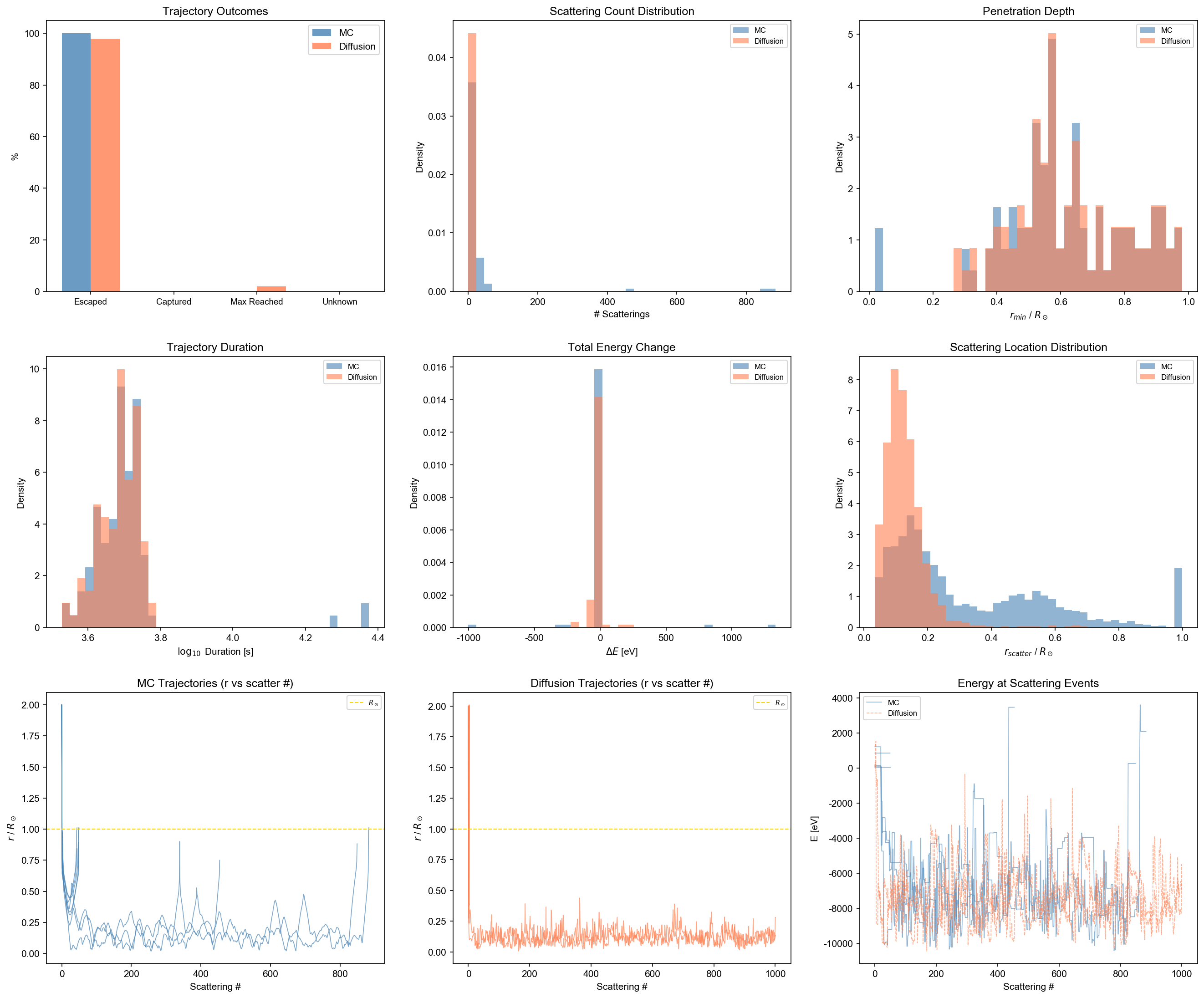
To overcome the computational bottleneck of traditional Monte Carlo trajectory sampling, I am developing DaMaSCUS-Diffusion — a machine learning approach that uses a FiLM-conditioned score-based diffusion model (VP-SDE) to replace MC scattering sampling:
- The model learns the conditional distribution of post-scattering states $(r, v_\text{rad}, v_\text{tan}, E)$ given pre-scattering conditions, exploiting solar spherical symmetry
- Trained on ~5.2M scattering events extracted from DaMaSCUS-SUN MC simulations
- Achieves < 3% normalized Wasserstein error across all physical dimensions while providing ~1000× speedup (milliseconds vs. seconds per trajectory)
- Gravitational orbit propagation is still handled by exact RK45 integration — only the stochastic scattering step is replaced by the learned sampler